Showing posts with label German Food. Show all posts

Thursday, 25 December 2014

Christmas Eve Celebration in Germany

Sending of Christmas greetings through social networkings. Merry Christmas from the Little Warrior.

Traditional Christmas Eve dinner is taken at the normal dinner  time unlike in some countries like the Philippines when they have Noche Buena in the middle of the night inviting friends and other clan members. In Germany, it is shared normally by the so-called nuclear family, the parents and their children. Other family or clan members can come for a visit on the first or second day of Christmas so with invited friends. For this dinner, it starts with hot and delicious pumpkin soup.

To eat goose, turkey or beef? To settle the question, the hostess decides for something wild-Rehragout, venison gulasch. Soft meat, a bit spicy, and one is comforted with the thought that the meat is not full of antibiotics. Well...

To go with the Rehragout, Spätzle is served. Spätzle is a soft egg noodle or dumpling popular in Southern Germany.

Salad is never lacking. As photo shows, it is tomato and rucola combination.

Pears in red wine accompany the wild meat.

Red cabbage with apples as side dish.

For dessert, the dear hostess surprises us with her perfect mousse au chocolat.

The tempting combination of dark and white chocolate served with raspberry.

Christmas Eve means for many kids "Bescherung." This is the handing out of Christmas presents from their parents to the kids and how many gifts are handed out for each child. Kids start to play doctor ready to treat patients with the toy First Aid Kit.

The little girl needs coaching to complete her Christmas song.
 
She is so fascinated by the first-aid kit present and willingly poses for a photo. How charming! 

Merry Christmas!

Sunday, 27 April 2014

Time for Asparagus

"Asparagus inspires gentle thoughts."
Charles Lamb

Late in March this year, while doing our power walking, we passed by these covered rows in our village and instantly thought, Asparagus. They're cultivating asparagus in this area.We were quite surprised as we have not seen any asparagus cultivation in our place.

After a month of absence, we continued our early morning walks passing now a colorful fields of rapeseeds and other green grains, young strawberry plants side by side with harvested fields now brown and waiting for new planting.

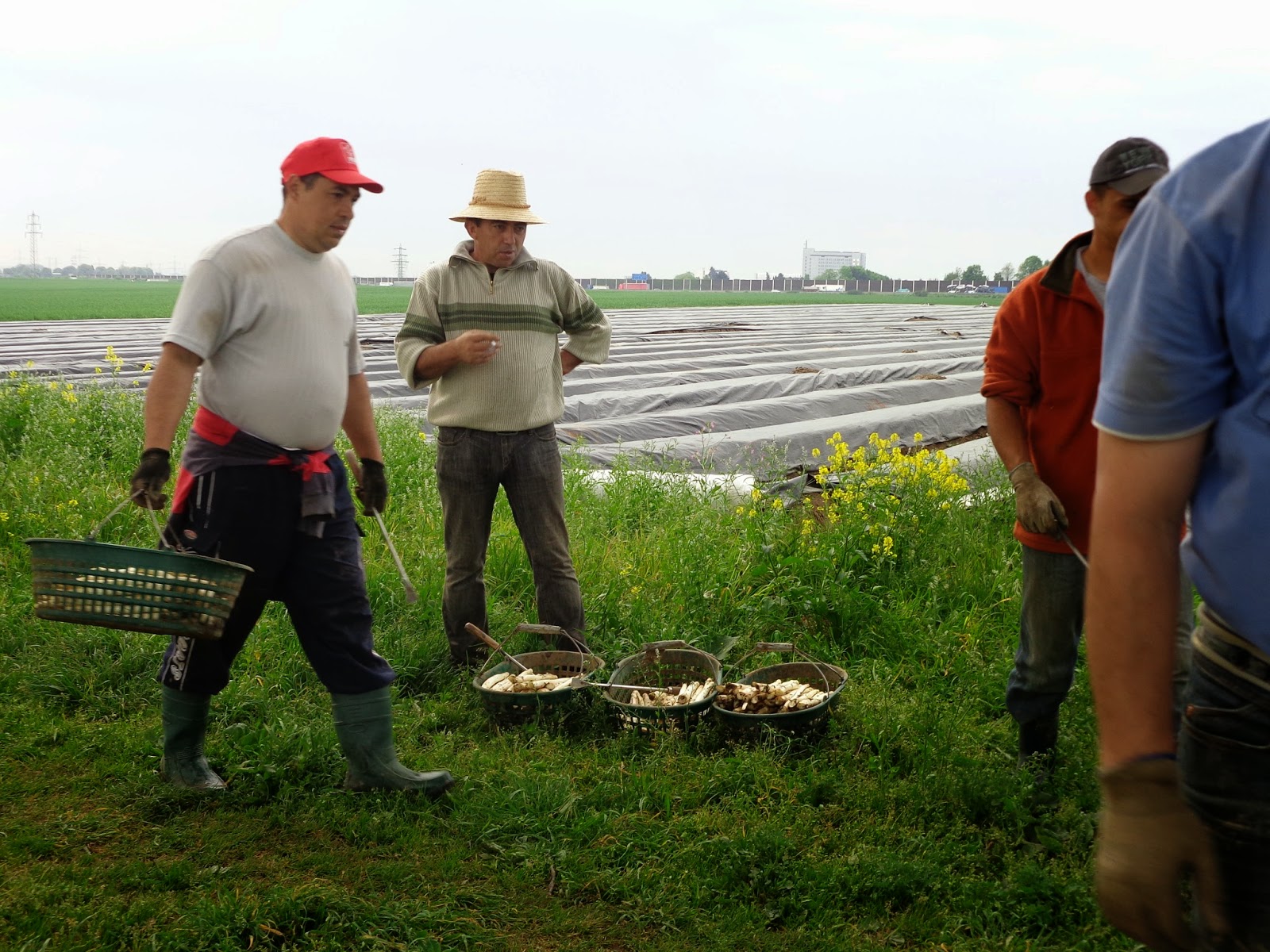
 Then we came nearer to the fields now full of workers, bending, lifting the covering sheets, and we know they're harvesting asparagus. In German it is called spargelstechen or to cut asparagus.

 The white and dark covering made of vinyl materials have two functions like that of the green house effect. If the weather is still very cold, the dark side is facing outside to keep the right temperature for the growth of the asparagus and white covering facing outside to avoid extreme hot temperature. When it gets hot, one says that asparagus get cooked.
 While taking shots of them from afar, this worker has been very friendly, waving to me as he notices that I've been taking photos of them or could he be saying No?
 The sequence of the hard work of harvesting asparagus: checking every row, lifting the cover and looking for the ones ready to be cut. Asparagus can grow up to 15 cms. per day from a humus, sand rich soil.
 The friendly, handsome worker is from Romania. The guest workers in this photo come from Romania. Most of the guest workers in Germany come from Poland and Romania, and they stay for at least three months working in the fields earning 6 to 7 Euro per hour. (I really hope they get that much payment for this back-breaking work.) Asparagus season lasts until about June 24 every year.
Freshly harvested asparagus-bio ones

My first basketload of asparagus...just posing out of delight.

One worker gave me his working knife to complete the ops for the  photo.

 Talking with them, I noticed that they understand more English than German as I started my questions in German but they readily answered when I started conversing in English. Didn't protest when I asked for permission for taking photos. Thank you very much for your kind approval.
I asked if we could buy the freshly harvested ones but one worker answered that we get them from the bio-shop in the village. Here they are preparing to leave the fields to go back the next day for another spargelstechen. Somehow they reminded me of OFWs working somewhere in this world, staying away from the their families to earn a living.

The white gold as served in local restaurants with pork chops, cutlets, scrambled eggs, ham and potatoes with cleared butter or Hollandaise sauce for prices ranging from 12 to 16 Euro for a plate with a half-kilo asparagus.

Wednesday, 27 March 2013

How Much Meat Do You Consume in a Lifetime?

You eat in your lifetime: 4 sheeps, 4 cows, 12 geese, 46 pigs, 37 ducks, 46 turkeys, 945 chickens
Meat Consumption per Head in 2012 (Source of Info: Kölner Stadt-Anzeiger, 14.01.2013)

Are you still thinking of eating meat on Good Friday? Why not try some lobsters for sacrifice and abstinence? 

Pinay von Alemanya


Sunday, 22 July 2012

Bienenstich on One Sunny Sunday

 Caramelized almonds as toppings
German Merienda - Bienenstich or Bee Sting Cake

Bienenstich or Bee sting cake is a German dessert made of a sweet yeast dough with a baked-on topping of caramelized almonds and filled with a  vanilla custard, buttercream or cream.
The cake may have earned its name from its honey topping: according to one legend, a bee was attracted to it, and the baker who invented the cake was stung.
Another source cites a legend of German bakers from the 15th century who lobbed beehives at raiders from a neighboring village, successfully repelling them, and celebrated later by baking a version of this cake named after their efforts.
(Source: wikipedia)